Showing posts with label civil war. Show all posts

Friday, April 6, 2012


Coming to Visit Historic Wilmington, North Carolina this summer? 

Tour Group Discounts. 5 Star Story Tellers!

Always a good Day for a Haunted Cotton Exchange or a History Walking Tour!


Group Discounts with 10 or more, age 12 and under FREE with adult.  Great for bus tours groups, clubs,schools, family reunions, company outings, fund raisers..


Fun for the whole family!
Call for Tour Times
Call 910-409-4300
E Mail Tour Old Wilmington

Tuesday, March 27, 2012

18th - 19th Century Canals in North Carolina

   With limited ocean ports and poor river navigation, North Carolina faced difficult transportation obstacles in its early years. Most trade went through Virginia or South Carolina. In order to improve transportation, numerous attempts were inaugurated during the late 1700s and early 1800s.


Collins (Somerset) Canal
   A canal completed in 1788 connecting Lake Phelps with the Scuppernong River. Dug by slave labor, the canal was used for navigation of lumber, rice and other materials, as well as to drain surrounding land. Length: 6 miles. (near Cresswell, NC)

Dismal Swamp Canal   A canal was first suggested in 1728. In December 1786, Virginia and North Carolina leaders reached an agreement to build the Dismal Swamp Canal to connect the Pasquotank River and Albemarle Sounds to Deep Creek, VA, and the Norfolk tidewater area. A private company, the Dismal Swamp Canal Company began construction in 1793 at both ends of the route. By 1796, costs were far exceeding projections, so digging was temporarily halted, while work began on building a road to connect the two canal segments. The road was completed in 1802 making a freight route possible.
  
 Work resumed on the canal digging and the completed canal was open in 1805 to flatboat and barge traffic. The canal would always be affected by dry seasons and droughts. In 1814, a 20-ton, decked vessel passed through the canal, marking the first large boat to make the transit.
  
 In 1827 - 1829, improvements were made in the canal to allow larger vessels with deeper drafts. In 1892, the Lake Drummond Canal & Water Company takes over the ownership and operation of the canal. The federal government purchased the canal in 1929.

Running basically north and south, this is the oldest man-made canal in continuous operation in the United States.
  
Benjamin Jones of Camden Co. (NC) was the only North Carolinian on the first board of directors of the Dismal Swamp Canal Company, since most of the financial support for the effort came from Virginia.
Length: 22 miles; Width (after 1829): 40 feet; Depth: originally 4 feet, later increased to 6.5 feet.

Cross Canal
This canal was opened in 1822. Ford B. Sawyer and Samuel Proctor were the  initial proprietors of the
Cross Canal in 1816 acquiring land to connect the  Dismal Swamp Canal to Gates County (NC). The canal ran parallel to the state border.
Length: 11 miles.

Roanoke Navigation Company & the Weldon (Roanoke) Canal

 The Roanoke Navigation Company was chartered in 1812 and began construction in 1817 to build the Roanoke (sometimes referred to as the Weldon) canal around a nine-mile, 85-foot drop at Great Falls on the Roanoke River. The work was completed in 1823.  This canal opened boat traffic from the valleys of the Dan and Staunton to the North Carolina coast.
  
Tolls collected from boats traveling the canal were $1,825.00 in 1830 and $12,190.22 in 1840. Railroad connections at and near Weldon, NC,  in 1840 began a shift in freight transportation. The canal was abandoned around 1850.
Length: 12 miles in length.

Clubfoot & Harlowe (Harlow's) Creek Canal
  
 Discussed prior to the Revolution, the canal never got underway in the 18th Century. Construction and planning got underway in 1795. In 1815, the North Carolina legislature authorized the formation of the Clubfoot and Harlow's Creek Canal Company. A turf lock was completed in 1821, but failed. A more structurally sound lock was finished toward the end of the 1820s. The canal was in full operation by 1827. This canal linked Beaufort, NC and Pamlico Sound & New Bern(e). When the lock at Harlowe fell into disrepair in 1856, the canal was abandoned.
  
In 1880 it was re-opened as the New Berne and Beaufort Canal. The government acquired the canal in 1891.
Note: In 1911, a new canal was created two miles east of this waterway — Adams Creek-Cross Creek Canal.
Length: 5-6 miles. Depth: 4 feet.

Bean Shoals Canal
   Designed to bypass some falls in the upper Yadkin River, this never-completed, three-mile canal was worked on from 1820 to 1825 by the Yadkin Navigation Company. There were to be three wooden locks. Construction required an extensive retaining wall be built between the canal and river. The project was so expensive that only 2 miles of the canal were built and the effort was abandoned without the canal ever being operational. A retaining wall remains.

Albemarle & Chesapeake Canal
   The first canal company for this route was initially authorized in 1772. In 1809, another legislative bill created the Great Coastwise Canal & River Navigation Company to build the waterway. More private companies would be authorized and supercede this company over the decades.
  
Canal construction finally began in 1855. Opened in 1859, this canal provided access to larger ships than the Dismal Swamp Canal. The Albemarle & Chesapeake Canal linked Norfolk area (through the south branch of the Elizabeth River) to New Bern and Washington, NC through the canal (North Landing River & Currituck/Albemarle Sounds). The federal government bought the canal in 1913.
Length: 10 miles. Depth: originally 6 feet, later increased to 8-foot draft.

   In addition to canals, there were numerous companies incorporated to deal in other ways with making North Carolina's rivers more navigable. Their actions included building locks, constructing short canals around rapids, dredging channels and clearing obstacles. Among these companies was the Cape Fear Navigation Company (attempted to build short canals and locks in the 1820s but suspended effort until the 1840s — only one steamer known to use these short canals (one is the
Lockville Canal). The Cape Fear Navigation Company was chartered in 1796).
  
 Other efforts to either build canals or improve rivers were the Neuse Navigation Company (1818 - 1825), Yadkin Navigation Company (see Bean Shoals Canal, above), the Tar River Navigation Company, the Catawba Navigation Company (1827 - ; president Isaac Thomas Avery) and the New River Navigation Company. Very little came out of these efforts as state financial support was minimal ($185,000 in stock for all of these companies) compared to the amount that might actually be required.  
 

 Used with permission from: NC Business History  Source:    http://www.historync.org

Saturday, March 24, 2012

Confederate States Navy (in North Carolina)


Students of the Civil War often overlook the contributions of the naval services in the conflict.  The Confederate Navy and Marine Corps, however, played significant roles in North Carolina.  They not only hampered the ability of the Union Navy to do its job, but took part in some of the state’s largest battles.

Genesis of the Confederate Navy
At Montgomery, Alabama, the Confederate Congress created a Navy Department in February 1861.  Stephen R. Mallory of Florida was selected by President Jefferson Davis to lead the department and was confirmed by Congress on May 5.  Mallory appeared capable of leading the new navy due to his service on the U.S. Senate Naval Affairs Committee prior to secession.  The newly created navy absorbed the state navies of South Carolina, Florida, Louisiana, Texas, Alabama, Virginia, and North Carolina.  These state navies, however, only consisted of about a dozen small ships, mounting few guns.  By war’s end the Confederate Navy managed to put 130 ships into service--a far cry from the 670-vessel US Navy.  The disparate numbers should not be considered a failure on Mallory’s part, however, for he performed as well as could be expected considering the circumstances; a lack of government interest and funding throughout the war hampered Mallory’s efforts.
The Confederate Navy’s mission was three-fold.  First, it was to provide coastal defense and protection for inland waterways.  Second, its ironclad construction program was designed to break the Union blockade of the southern coast.  Third, it was seen as a function of the navy to raid enemy commerce.  Today, students of the Civil War remember the Confederate Navy primarily because of the exploits of the CSS Alabama and CSS Shenandoah.  Two North Carolinians commanded Confederate cruisers: James I. Waddell (CSS Shenandoah) and John N. Maffitt (CSS Florida).  While the Confederate Navy was moderately successful at commerce raiding, it never provided an adequate coastal defense or broke the Union blockade.

The Confederate Navy and Marine Corps played a significant role in North Carolina because much of the war in the state involved coastal operations.  Early in the war, North Carolina contributed what was nicknamed the “Mosquito Fleet,” a small force of lightly armed vessels, to the Confederate cause.  During the 1862 Burnside Expedition in coastal North Carolina, these ships participated in the Battle of Roanoke Island, and all but the CSS Beaufort were subsequently destroyed during the Battle of Elizabeth City. These battles ended what little threat the fleet posed to the Union forces.

North Carolina Ironclads
The Confederate government attempted building ironclads in the state, and was successful in completing four ships: the CSS North Carolina and the CSS Raleigh on the Cape Fear River, the CSS Albemarle on the Roanoke River, and the CSS Neuse on the Neuse River.  There were also naval yards and stations located across the state, including a large operation at Charlotte for manufacturing marine machinery and other facilities in Wilmington, Halifax, Kinston, and for a brief time in Tarboro.

Aside from the Burnside Expedition, the Confederate Navy and Marine Corps conducted numerous operations throughout coastal North Carolina.  In early February 1864, Commander John Taylor Wood led a detachment of thirty-three officers and 220 enlisted sailors and Marines downriver from Kinston to New Bern, where they boarded, captured, and destroyed the USS Underwriter in one of the most daring missions of the Civil War.

The Kinston-built ironclad, CSS Neuse, was completed shortly after Wood’s expedition to New Bern.  Confederates hoped that the ironclad might help recapture the old colonial capital.  On its voyage downriver, the Neuse ran aground in a shallow portion of the river and was not freed until a month later.  By then, all operations in eastern North Carolina had ceased because army units had been recalled to Virginia to assist in the defense of Richmond.  The Neuse waited ten months to be called into service--this time to cover the evacuation of Kinston following the Battle of Wyse Fork in March 1865.  The ironclad was taken downriver.   Its cannons bombarded the Union Army while Confederate troops abandoned the town.  Once the evacuation was complete, the Neuse was scuttled to prevent capture.

In mid-April 1864, the ironclad CSS Albemarle, captained by Commander James W. Cooke, helped Confederate forces recapture the town of Plymouth.  The Albemarle rammed and sank the USS Southfield and successfully battled the USS Miami which lost its captain, Lieutenant Commander Charles Flusser in the fight.   In early May 1864, the Albemarle steamed for New Bern to help retake the city from Union occupation forces.   Not very long after departing Plymouth, the Albemarle and two smaller ships, the CSS Bombshell and CSS Cotton Plant engaged seven Union warships as they entered the waters of the Albemarle Sound.  The ensuing battle was fierce, with the Union vessels firing over 600 shots.  A riddled smokestack was the Albemarle’s most significant damage.  The loss of the ship’s smokestack and the use of inferior coal caused a loss of draft, making the ship nearly inoperable.  Without significant draft, the engines did not have enough steam to operate properly, so Cooke was forced to return to Plymouth.  In the end, the most successful North Carolina ironclad, the Albemarle, was sunk on October 27, 1864, by a spar torpedo at her moorings by a Union Navy commando raid.

Approximately at the same time the CSS Albemarle battled the Union fleet in the Albemarle Sound, the CSS Raleigh undertook the only offensive action of the war by the Confederate Navy at Wilmington.  At nightfall on May 6, 1864 the Raleigh escorted a number of blockade runners across the New Inlet bar near Fort Fisher and attacked Union ships on blockade.  These targeted attacks continued throughout the night, and nearing daybreak on May 7, the ironclad came back into New Inlet and under the protection of the fort.  On its return trip upriver to Wilmington, the Raleigh grounded on a sandbar. Before the gunboat could be freed, its keel broke and the Raleigh sank.  The other Wilmington ironclad, the CSS North Carolina, never equipped with adequate engines, sank at its moorings in September 1864; marine worms had infested the hull.
Fort Fisher

The Confederate Navy and Marine Corps had significant involvement in the two battles at Fort Fisher and the Wilmington Campaign.  The Submarine Battery Service was instrumental in placing electrically detonated torpedoes in the waters of the Cape Fear to deter Union blockaders from attempting to enter the river.  The battery was also stationed at Fort Anderson to operate torpedoes in the river after the fall of Fort Fisher.

Battery Buchanan, detached from Fort Fisher, was built as a response to the ineffectiveness and loss of the CSS North Carolina and CSS Raleigh.  It was commanded and manned entirely by naval personnel and armed with two seven-inch Brooke rifles and two eleven-inch Brooke smoothbore guns, all considered to be “naval” ordnance.  The battery was commanded by Lieutenant Robert F. Chapman.  A twenty-nine-man detachment from the raider CSS Chickamauga, under the command of Lieutenant Francis M. Roby, manned another battery of seven-inch Brooke rifles in another part of the fort.  During the First Battle of Fort Fisher on December 24-25, 1864, both Brooke rifles, manned by Lt. Roby’s men, burst and injured nearly half the detachment and put the battery out of service.

Following the First Battle of Fort Fisher, fifty-one officers and men of the defunct Savannah Squadron (including nine African American sailors) arrived at Wilmington to reinforce the naval battery at Fort Fisher.  The Second Battle of Fort Fisher was fought from January 13-15, 1865.  Late in the battle, knowing that the fort was lost, Lt. Chapman abandoned his position, and his men escaped across the river.  Sailors then temporarily manned Batteries Meares and Campbell on the west bank of the river but soon resumed retreating toward Wilmington as the Union forces pushed toward the town.  All vessels, records, drawings, and buildings at the shipyards were destroyed while the navy evacuated Wilmington ahead of the Union army.
Conclusions

Throughout the war, the Confederate Navy and Marine Corps did their best to help protect the coast and rivers of eastern North Carolina.  Though not always successful, the naval forces were almost always a factor in any action.  The inadequate naval yards of the state managed to produce four ironclad gunboats as well as marine machinery and desperately needed parts.  Native North Carolinians served in many capacities, from common sailors and blockade-runner pilots to cruiser captains, and contributed greatly to the war effort.  The problems in North Carolina, however, revealed a much larger problem:  the Confederate Navy never had enough resources, manpower, or time to accomplish strategic goals.


Sources:
Leslie S. Bright, William H. Rowland, and James C. Bardon, CSS Neuse: A Question of Iron and Time (Raleigh, 1981); R. Thomas Campbell, Storm Over Carolina: The Confederate Navy’s Struggle for Eastern North Carolina (Nashville, 2005); Richard G. Elliott, Ironclad of the Roanoke: Gilbert Elliott’s Albemarle (Shippensburg, 2005); Chris E. Fonvielle, Jr., Last Rays of Departing Hope: The Wilmington Campaign (Campbell, CA, 1997); Rod Gragg, Confederate Goliath: The Battle of Fort Fisher (New York, 1991); Richard A. Sauers, The Burnside Expedition in North Carolina: A Succession of Honorable Victories (Dayton, 1996); William N. Still, Jr., The Confederate Navy: The Ships, Men and Organization, 1861-65 (Annapolis, 1998); and William N. Still, Jr., Iron Afloat: The Story of the Confederate Armorclads (Columbia, 1971).
By Andrew Duppstadt, North Carolina Division of State Historic Sites

Thursday, February 2, 2012

History of Wilmington NC


Tour Old Wilmington 
According to the Julian calendar, Wilmington, North Carolina, was incorporated in 1739.  Located on the east bank of the Cape Fear River, the original town is 28 nautical miles from the Atlantic Ocean.  Built on several rises, more like sand dunes than hills, the town ascends 50 feet from the river shoreline.  Despite navigational difficulties along the river, the town grew to become the largest city in the state before the Civil War.  It remained so until the second decade of the 20th century, when the state’s Piedmont tobacco and textile towns rose to prominence. 

Wilmington’s historical significance is reflected in the variety of architectural styles, streetscapes and in other aspects of its material culture.  The Colonial town is most visible in the original grid pattern of the streets, the numbered streets running from north to south and the named streets running from east to west.  Several periods of rapid growth have altered the city’s passage through time.  Very few buildings remain from the early town because of the large fires and antebellum growth stimulated by the 1840 opening of the railroad. 

Three other periods of sustained growth are also noteworthy.  Recovery from the Civil War with increased port and rail expansion precipitated substantial commercial activity in the late nineteenth and early twentieth centuries.  Increased business and industry, particularly of cotton and fertilizer, provide a building boom both commercially and residentially, including moves to the first suburbs.  This economic activity spread across the region, evident most notably in the development of the nearby beaches.  After a period of decline during the Great Depression, Wilmington experienced another burst of growth during World War II Military facilities and the North Carolina Shipbuilding Company brought an unprecedented number of new residents who needed housing as well as a myriad of businesses to support their daily lives.  The most recent growth can in the 1990s, after Wilmington was connected to the rest of the country by Interstate Highway 40. 


Source: Wilmington Lost But Not Forgotten by Beverly Tetterron

Friday, December 9, 2011

The Ghost of the Steamer Wilmington


The Steamer WILMINGTON (A Prezi Presentation)
On a recent visit to the “North Carolina” Room, of the New Hanover County Library in downtown Wilmington, NC, I found that they were having a “Book Sale.”  I walked over to the cart of books & pamphlets and started to look them over.  I’m sure my eyes lit up when I recognized the face of a small pamphlet which was enclosed in a clear plastic cover.
A Colonial Apparition Booklet 1909The title of the pamphlet was “A Colonial Apparition” with the author being James Sprunt.  I quickly recognized a picture of the Steamer WILMINGTON on the cover.  An attached note said that the booklet was $5. I asked the library representative if she realized that this was an important artifact, “as important as some of those items over in that display case,” I said.  She told me that she was not the usual librarian.  I continued to look through the items for sale, and found a large, old black Bible, KJV, also for $5.  When I started to pay, I only had a $20 bill, and the librarian said she didn’t have change, but I could either “pay by check” or go downstairs to get change.  I wrote out the check.


I wasn’t familiar with the story set out in the pamphlet, but when I got back to my apartment in Fayetteville, I sat on my sofa and started to read.  I immediately became excited by the imagery created by reading the first pages.  I always like developing visual images & vignettes from written words.  I like when something comes to life.  When I can take a description and meld it with my personal experiences and imagine the scene as if I were, or had been, there when, or as it happened.  I understood the first paragraph completely as it described the many winters I had grown up near Swansboro, NC,  “A biting storm of sleet and snow is  seldom seen in Wilmington.  For many years the winter season passed with scarcely frost enough to chill the poor, and then a Christmas season came that will long be remembered for the rigor of its cold..“  It was rare for Christmas or the whole winter season to find snow upon the ground.  If one of my presents was a new football, then I just needed to put on my sweater and coat and head outside to throw the ball around, to myself.  Cold, but not even a dusting of snow on the ground.


The Southport mail boat, Wilmington, made her daily runs without a break,… Captain Harper knew his craft and kept her well in hand.  With steady stare ahead and vice-like grip upon the wheel, he safely steered her up and down, without an accident…
With plank hauled in, the rail secured and hawser neatly coiled, the stately steamer shaped her course.  But ere the double bells were rung, a little rivet broke away from thousands of its kind, and soon caused trouble with the furnace fires.  There was a pause; then a parley through the speaking tube revealed the fact that nothing less than six hours’ work would “mend the kettle” in the engine room…
As the story continued, the passenger’s (Mr. McMillan) historical references addressed to the captain, began to put me to sleep, and these I started to skim, but eventually, we were back upon the deck of the steamer, along side of the Mate, Peter Jorgensen, as he came “face to face” with a hideous haint.  A haint, by the way, is an apparition, and as we mostly call them today, a ghost.  Later, I stood upon the deck of the steamer as all eyes gazed upon the apparition of the kilted Scots.  And when they disappeared, we were almost immediately upon the wreck of a capsized vessel, and clinging to that vessel, two seamen, survivors, but both near the end of their lives. Then quickly came the rescue and arrival of the steamer, at her wharf in Southport, and the brightening sky of Christmas morn.  The tale ended as we followed Captain Harper up to his home and inside, as he kissed his sleeping, “motherless boy.” I closed the pamphlet and put it down on the table, but as I did, I said to myself, but out loud, “Wow.  What a wonderful story!”  *If you would like to read this short story, Google has digitized a book version, which includes photos & drawings of Capt. Harper, the Mate, Peter Jorgensen, the Engineer, Mr. Platt and the Passenger, Mr. McMillan.  **And for more images and info regarding the WILMINGTON.
I made a note to find out when Mrs. Harper had died, for I knew that Capt. Harper had died about a week after the death of his 12 year old daughter, Ella.


NOTE: If you clicked on the link above, “vice-like grip upon the wheel”, and have looked at the image of the hurricane deck and wheelhouse of the Steamer WILMINGTON, you might note the search light on top of the pilothouse.  *I believe that I have read somewhere that this light was originally on the Steamer CITY OF FAYETTEVILLE.  Attention to this advertisement, which includes a drawing of the steamer and a beam of light projecting forward from atop her pilothouse.


Just last night, I once again googled on “City of Fayetteville” and found an index which referenced an article, in the “Marine Engineer” magazine, regarding the steamer.  I then searched to see if this magazine were available online and found it.   Google had digitized the “Marine Engineer” magazine, Vol. 7, which included the June 1902 issue and the article entitled, “Stern Wheel River Steamer.”  The drawings included were of the steamer’s profile, her saloon deck, her engine and a cross-section of the boat.  All “priceless” to a better understanding.

My introduction to the Cape Fear River Steamers came when I first read an account of the Great Fire of Wilmington, North Carolina of the 21st of February, 1886.
The fire started aboard the steamer Bladen which was approaching the end of her 120 mile journey, from Fayetteville to Wilmington.  About 150 yards from her dock, fire was discovered amongst bales of cotton, located near her boiler.  There was a strong, almost gale force wind blowing up from the Southwest, which whipped the flames and spread them quickly from bow to stern, forcing the passengers and crew to flee toward the boat’s stern paddlewheel.


There were eight passengers on board the Bladen that day, Mr. A. J. Harmon  of Bladen County, Mr. Robert Lee of Wilmington, Dodson, a commercial traveler, Mrs. Thomas Hunley and child, Miss Erambert of Richmond, Virginia, and a couple of other gentlemen whose names had not been learned.


Fortunately, several small boats were dispatched from both sides of the river when the alarm went out.  It was stated that for a brief time, before being rescued, Miss Erambert was in great danger, with her clothing being scorched and her hair singed.  All passengers were rescued, however, they lost all their baggage and personal belongings.
Captain R. H. Tomlinson and his mate, Capt. Jeff D. Robeson, were both aboard the Bladen at the time, and Capt. Tomlinson immediately headed the boat for the nearest wharf, that being the dock of the Clyde Steamship Lines.   The fire spread to a nearby lighter which was loaded with firewood and then to the wooden wharf, sheds and buildings along the waterfront.


In addition to the Bladen, another river steamer, the River Queen and a three masted schooner, the Lillie Holmes were burned “to the waterline” and sank where they were tied up.
The Wilmington Morning Star reported that, “Oil, tar, rosin and spirits turpentine in yards adjacent were ready fuel for the devouring flames, and in a very short time the whole river front from Chesnut to Mulberry was ablaze, and the stores and offices on the west side of Water street for the same distance, were enveloped.  The firemen fought manfully and determinedly, but their efforts were futile; nothing could stay the progress of the flames, which leaped and roared like a demon, sending aloft showers of sparks and burning brands, that the high winds carried and hurled on the roofs of buildings squares away from the raging conflagration.”
By the time the fire had been brought under control, the next morning, much of the Wilmington business district had been decimated including the railroad yards and warehouses.  The total estimate of the damage ranged from $500,000 to $1 Million.


I said that the reading of this account was my introduction to the Cape Fear River steamers.  Before reading the article, I wasn’t even aware that steamboats had, or could have run between Fayetteville, NC and Wilmington.  The image I had of a steamboat, at that time, was one like those portrayed in movies which ran on the Mississippi River, large, wide, multi-decked vessels, ornately adorned, capable of carrying hundreds of passengers, large cargoes of cotton, and an assortment of “riverboat” gamblers.  But, what I found were smaller, narrow, light draught vessels capable of navigating the winding Cape Fear, making their way at times, on just a couple of feet of water, sometimes not being able to travel at all because of “low water”, and then having to travel against or with the strong currents of freshets.


The steamboat captains, pilots, boat hands, owners formed an extremely tight-knit group where often, blood or marriage played a large part.  There were many negro pilots which plied the Cape Fear.


The era of the Cape Fear River steamers lasted about 121 years, roughly from about 1818 until 1939, when Capt. Henry H. Hunt tied his boat, the Thelma, up to her wharf at Elizabethtown, NC, where she was left to rot, till this day.  But, during that era, there were many well-known and beloved captains, many boiler explosions, fires, sinkings, drownings, freshets, picnics, excursions, and other incidents which are worth recounting.
And so, I will.

CFRS

Map of the Cape Fear River

Lori on the Cape Fear River  


Map of the Cape Fear River 

The Haunted Courthouse

The Haunted Courthouse
On the stairs of the old Courthouse

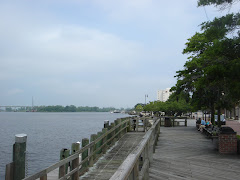
Cape Fear River

Cape Fear River
Looking west toward the Hilton

Ship coming into Port of Wilmington

Ship coming into Port of Wilmington

Ship News

Ship News